

Filemail has been around since 2008 and built a solid reputation as a reliable large file transfer service. The desktop apps for Windows, Mac, and Linux are genuinely good , they use UDP transfer acceleration for faster speeds, support resume on interrupted uploads, and have never had a reported data breach according to Filemail's own security page. For professionals who move large files regularly and want something dependable, it earns its place.
So why are people looking for alternatives?
Three things come up most often. First, the free plan caps you at 2 transfers per 24 hours and 5 GB per file, which is tighter than many comparable free tools. Second, password protection on the free plan is absent, which is a real gap if you handle confidential client files. Third, and most importantly for professionals who care about brand: Filemail's branding feature gives you a custom subdomain in the format yourstudio.filemail.com. The filemail.com portion of the URL never disappears, regardless of which plan you are on. A true custom domain where your own URL replaces filemail.com entirely is not available.
This guide covers 8 alternatives to Filemail in 2026 with verified facts, honest pros and cons, and source links for every key claim.
Filemail Free Plan Limits in 2026
| Limit | Filemail Free |
|---|---|
| Max file size per transfer | 5 GB |
| Transfers per 24 hours | 2 |
| Link expiry | 7 days |
| Password protection | No |
| Custom domain | No (subdomain only on paid) |
| Branding | No |
| Desktop app | Yes |
| Virus scanning | Yes |
What Filemail Does Well and Where It Falls Short
Where Filemail works well:
- Desktop apps for Windows, Mac, and Linux with UDP transfer acceleration for faster speeds than browser-based tools
- Resume support for interrupted uploads, available in desktop apps
- Mobile apps for iOS and Android with no ads on the free tier
- Microsoft Outlook plugin for sending large files directly from email
- Strong security: TLS-1.2/AES-256 encryption, virus scanning, 2FA on paid plans
- Compliance certifications on Enterprise: GDPR, HIPAA, ISO27001, SOX, FISMA
- Has been operating since 2008 with no reported data breaches
Where Filemail falls short:
- Free plan capped at 2 transfers per 24 hours, very restrictive for regular senders
- No password protection on the free plan
- Branding is a custom subdomain (
yourstudio.filemail.com). Filemail.com always stays visible in the URL - Pro plan ($12/mo) caps file size at 250 GB and links expire after 30 days. You need Business ($18/user/mo) for permanent availability and unlimited size
- No client-facing branded delivery experience. The download page is functional but not designed to impress
- Per-user pricing on Business plan gets expensive for larger teams
- Upload speeds can be slower on the web interface vs. the desktop app
Quick Comparison Table
| Tool | Custom Domain | Free File Limit | Free Transfer Cap | Starting Price | Best For |
|---|---|---|---|---|---|
| TrunkTransfer | Yes, fully custom (files.youragency.com) | 200 GB | Unlimited | $9/mo | Client delivery under your own domain |
| Smash | Enterprise only | No limit (2 GB priority) | Unlimited | Free / ~$10/mo | Unlimited free file size |
| SwissTransfer | No | 50 GB | IP-level daily cap | Free only | Large one-off free transfers |
| MASV | No | 15 GB/mo credit | Unlimited | Free / $0.25/GB | Video production, broadcast |
| TransferNow | No | 5 GB | No cap | Free / ~$7/mo | Teams, frequent senders |
| WeTransfer | No | 3 GB/mo total | 10/mo | Free / $8/mo | Brand recognition |
| Dropbox Transfer | No | 100 MB (free) | Unlimited | ~$10/mo | Existing Dropbox users |
| Google Drive | No | 15 GB (shared) | Unlimited | Free / $2.99/mo | Internal team sharing |
The 8 Best Alternatives to Filemail
1. TrunkTransfer
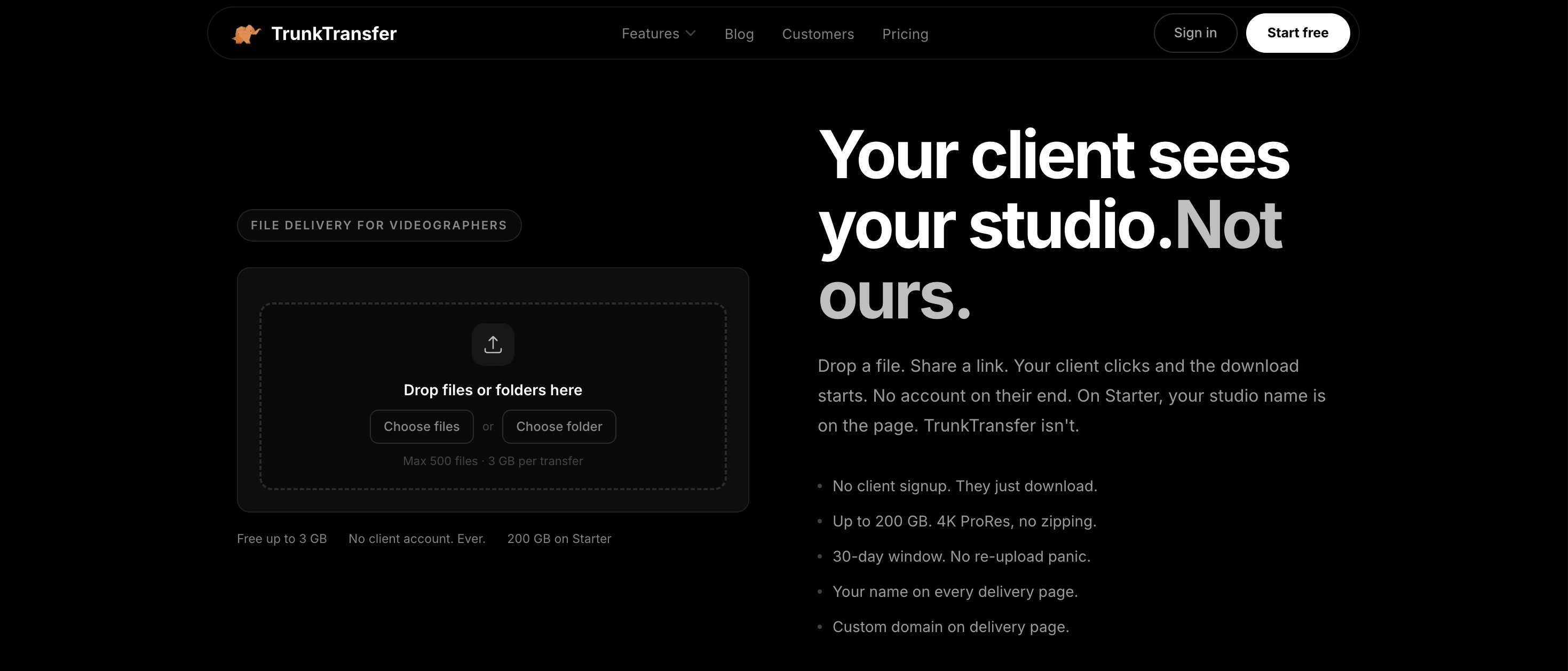
Best for creative professionals delivering work to clients
Filemail is a reliable file transfer tool. TrunkTransfer is a client delivery tool. That distinction sounds subtle but it shapes every design decision in both products.
When your client receives a TrunkTransfer delivery, they land on a page with your logo, your studio name, and your own domain in the browser URL. Not filemail.com. Not trunktransfer.com. Just your brand. Filemail's branding feature gives you a custom subdomain (yourstudio.filemail.com), which looks more professional than a generic link, but filemail.com stays in the URL regardless of which plan you pay for. Your client still sees a third-party platform name, which subtly reminds them that you are using someone else's tool.
TrunkTransfer's custom domain is available on the Starter plan at $9/mo. No Enterprise pricing, no custom quote required. For the full feature breakdown: branded file delivery for agencies. Or read the guide: What is Branded File Delivery?
Beyond the domain, TrunkTransfer solves two other gaps that show up in Filemail's design. First, delivery confirmation: TrunkTransfer notifies you when your client opens and downloads the files, so you stop sending follow-up emails asking if they received everything.
Filemail has download tracking on paid plans, but the experience is built around the sender's dashboard, not around a clear "your client got it" notification. Second, client friction: recipients on TrunkTransfer need no account, no app, no plugin , they click the link and download. Filemail sometimes encourages recipients to download the desktop app for better performance, which adds a step that not every client will follow through on.
The Starter plan at $9/mo (or $6/mo billed annually) covers 200 GB per transfer with 30-day links and full custom domain, backed by a 7-day free trial.
The key difference from Filemail: Filemail is optimized for reliable file movement. TrunkTransfer is optimized for the impression your delivery makes on the client receiving it.
Pros
- Fully custom domain: your URL only, no TrunkTransfer name anywhere
- Branded delivery page with no client signup, no app prompt, no friction
- Delivery confirmation when files are opened and downloaded
- Starter at $9/mo includes 200 GB and 30-day links, with a 7-day free trial
- Flat pricing with no per-user fees that compound as your team grows
- No ads at any tier
Cons
- No desktop app (browser-based)
- Not designed for enterprise compliance workflows (HIPAA, SOX)
- Newer product with a smaller track record than Filemail
Pricing: Starter: $9/mo or $72/yr (200 GB, 30-day link) · 7-day free trial
Best for: freelance videographers, photographers, graphic designers, and agencies who want client deliveries under their own domain with no third-party platform visible
2. Smash

Best for unlimited free file sizes without a daily transfer cap
The most direct Filemail limitation that Smash addresses is the 2 transfers per 24-hour cap on Filemail's free plan. Smash has no such cap: unlimited transfers, no file size limit, no account required. Files over 2 GB go into a lower-priority queue, but for most casual or mid-volume use it is not a significant delay.
Smash also includes password protection on the free plan, which Filemail's free tier does not. Both tools offer branding via custom subdomain on paid plans, though Smash's true custom domain (CNAME) is Enterprise-only, the same limitation as Filemail.
Pros
- No file size limit on the free plan
- No daily or monthly transfer cap
- Password protection included free
- Customizable sharing URLs on free tier
- Available on web, iOS, Android, Mac, and Outlook plugin on paid plans
- GDPR compliant with EU servers
Cons
- Files over 2 GB enter a lower-priority queue on the free plan
- All transfers expire , 30-day maximum even on paid plans
- True custom domain is Enterprise-only, same gap as Filemail
- No delivery confirmation on free plan
Pricing: Free (unlimited size, 7-day link) · Pro: approx. $10/mo
Best for: anyone switching from Filemail's free plan who needs unlimited transfers and no daily cap
TrunkTransfer vs Smash: full comparison
3. SwissTransfer
Best purely-free option for large files
SwissTransfer allows up to 50 GB per transfer, completely free, with no account required and no ads. That is 10 times Filemail's 5 GB free limit and no 2-transfer daily cap. Links stay active for up to 30 days.
SwissTransfer is built by Infomaniak, a Swiss hosting company, and has no paid tier at all. That means no upgrade path and no enterprise features, but for anyone who just needs to send large files without a subscription, it is the most generous free tool available.
All data is stored in Switzerland under Swiss privacy law, with AES-GCM in transit and AES-256 at rest , as strong a security posture as Filemail for free use.
Pros
- 50 GB free per transfer, no account required
- No daily transfer cap (though a per-IP limit applies for very heavy use)
- 30-day link expiry
- Strong encryption and Swiss data jurisdiction
- iOS and Android apps with download tracking
Cons
- No paid plan , feature set is permanently capped
- No branding, no custom domain, no delivery confirmation
- No team or multi-user support
- Web interface has no download tracking (mobile app only)
Pricing: Free only (50 GB, 30-day link) · No paid tier
Best for: occasional senders who need large file transfers for free, with no daily cap and no subscription
4. MASV
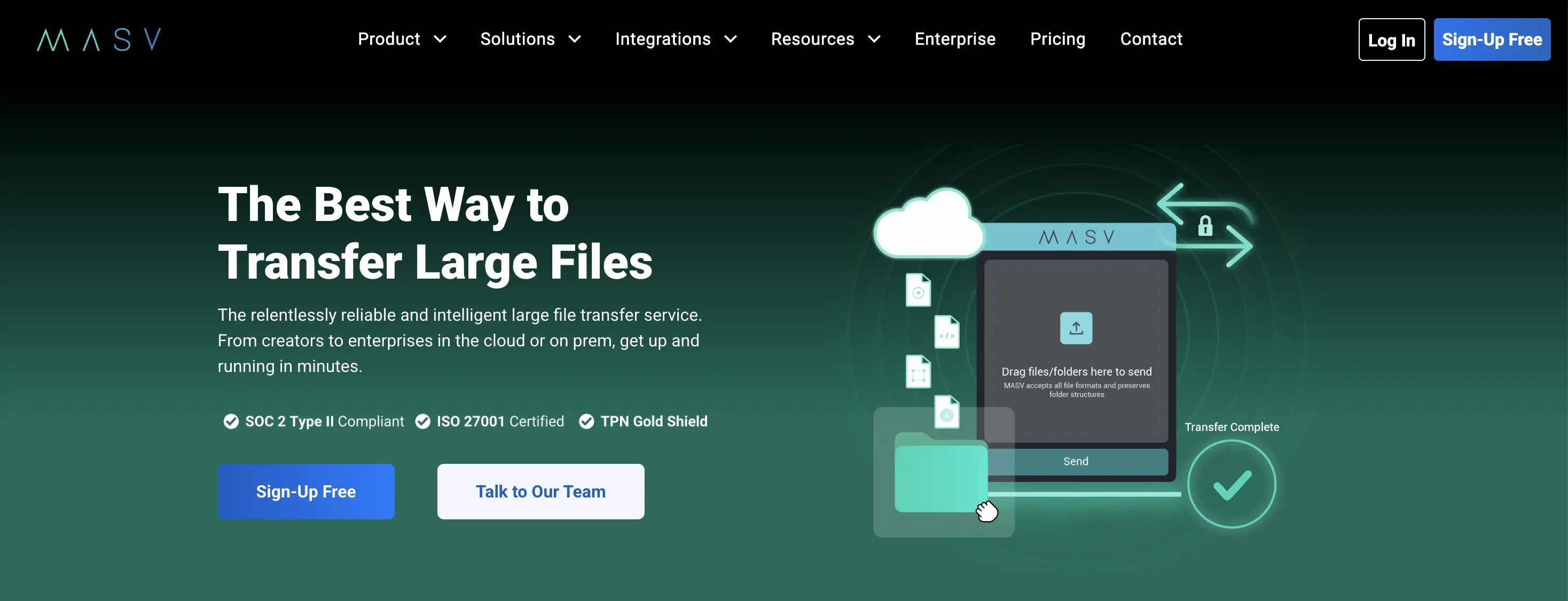
Best for video production and broadcast teams
Where Filemail uses UDP acceleration in its desktop app for faster speeds, MASV takes that further , it is built on a proprietary accelerated network delivering speeds up to 10 Gbps over a private global infrastructure. For studios moving multi-gigabyte camera rushes, color grades, or audio sessions on a deadline, that speed gap matters.
MASV offers 15 GB of free transfer credit per month. Beyond that, it charges $0.25 per GB. One thing to watch: MASV charges per egress (download), not per upload. If a client downloads a 50 GB file twice, you are billed for 100 GB. Setting a download limit per transfer keeps costs controlled.
Filemail's Enterprise plan targets compliance-heavy industries. MASV targets speed-critical production workflows. Different problems, different tools.
Pros
- No file size limit , up to 15 TB per transfer
- Significantly faster than any HTTP or even standard UDP tool
- 15 GB free monthly credit
- Branded portals available
- Trusted by broadcast studios and post-production houses
Cons
- Charges per download (egress), not upload. Costs compound with multiple downloads
- $0.25/GB adds up fast (1 TB = $250)
- Credit card required at signup even for free tier
- No custom domain
Pricing: 15 GB free monthly · $0.25/GB pay-as-you-go · Subscription plans for high-volume use
Best for: video production companies, post-production studios, and broadcast teams where raw transfer speed is the primary requirement
TrunkTransfer vs MASV: full comparison
5. TransferNow
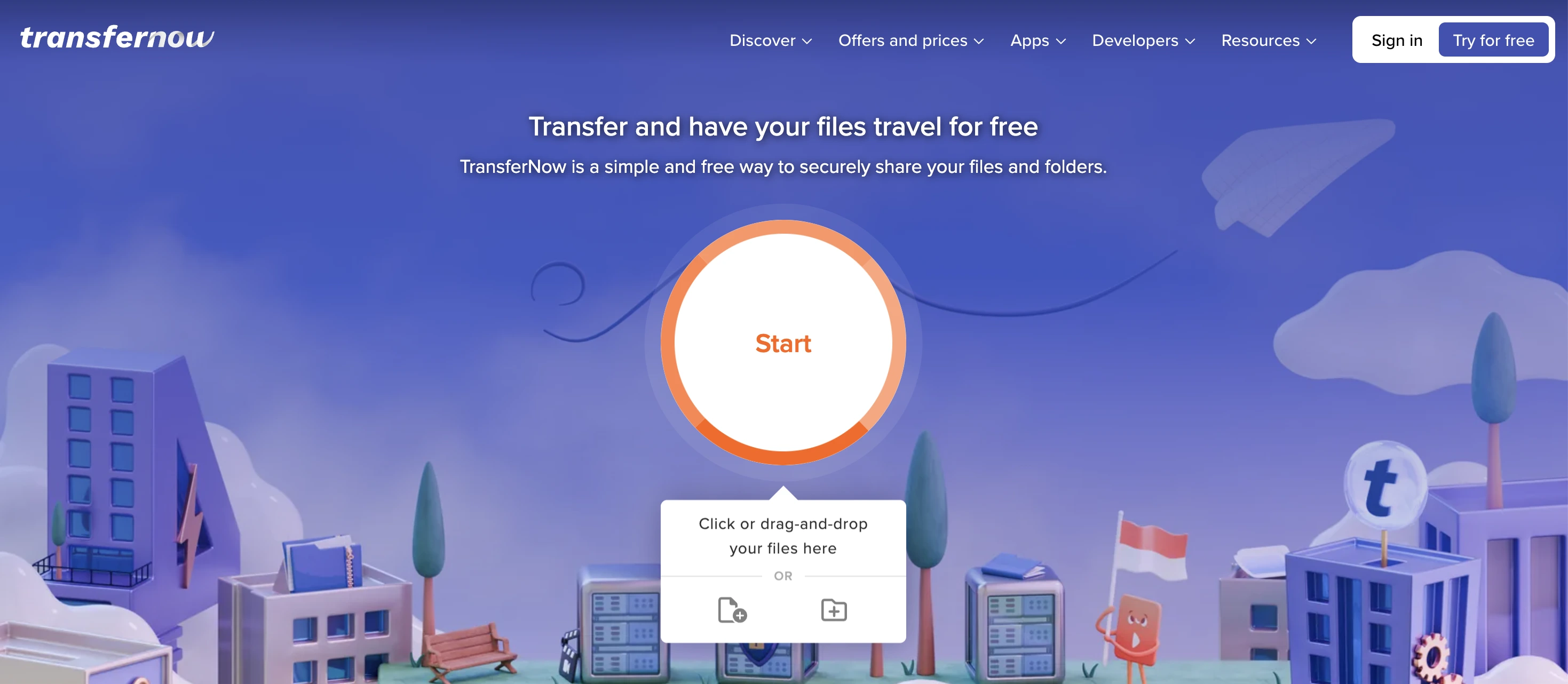
Best for frequent senders who need no daily cap
TransferNow's free plan offers 5 GB per transfer with no monthly cap and no daily transfer limit. This is a direct improvement over Filemail's 2-transfer per day restriction. You can send as many transfers as you need without running into a wall.
Password protection is available on the free plan, matching Smash and beating Filemail's free tier. Paid plans add branding, extended expiry up to 365 days, and an embeddable file request widget.
Pros
- 5 GB free with no daily or monthly cap
- No account required
- Password protection on the free plan
- Up to 365-day file retention on paid plans (beats Filemail Pro's 30-day max)
- Flat-rate team pricing
- GDPR compliant
Cons
- Free tier shows ads
- Branding requires a paid plan (custom subdomain only, no true custom domain)
- No delivery confirmation
- No desktop app or Outlook plugin
Pricing: Free (5 GB, 7-day link) · Paid plans from approx. $7/mo
Best For: frequent senders who hit Filemail's 2-transfer daily cap and want a no-cap free alternative
TransferNow vs TrunkTransfer: full comparison
6. WeTransfer
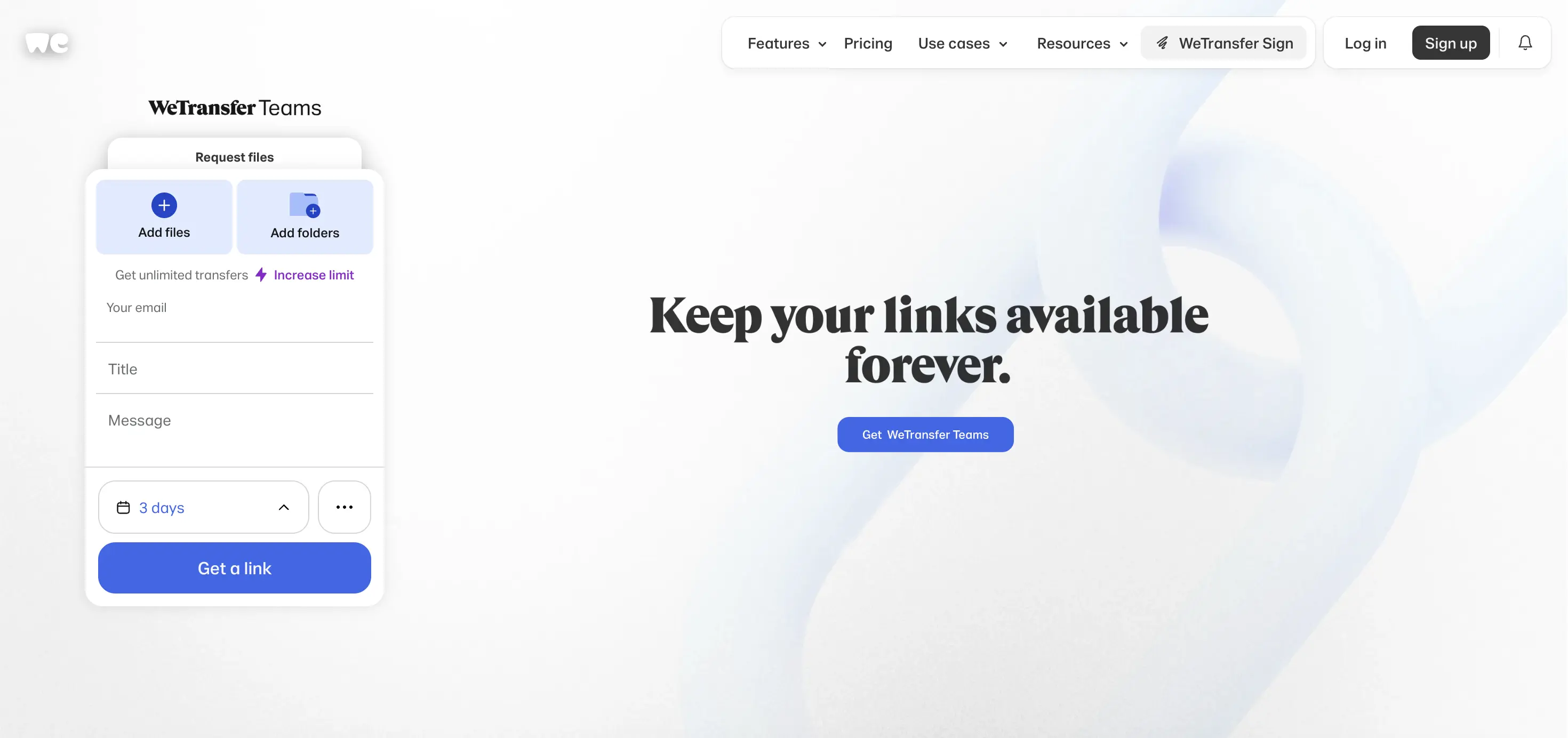
Weaker than Filemail on almost every free-tier metric
WeTransfer gets included on most file transfer comparison lists because of name recognition. But compared directly to Filemail, it is the weaker tool in almost every measurable way. The free plan caps at 3 GB total per 30-day rolling window with a 10-transfer limit, vs Filemail's 5 GB per transfer. Free links expire in 3 days, vs Filemail's 7. There is no desktop app with UDP acceleration, no resume support, and no compliance certifications below the top tier.
WeTransfer permanently shut down its Portals and Reviews features on December 22, 2025 following its acquisition by Bending Spoons. If you were using WeTransfer for structured client delivery, that option is gone. TrunkTransfer is the closest replacement for that workflow, with a branded delivery page and custom domain that WeTransfer never offered on any plan.
Pros
- Familiar brand name that most clients recognize
- Clean, simple interface
Cons
- Free plan much weaker than Filemail (3 GB total per month, 3-day link expiry)
- 10-transfer monthly cap on the free plan
- Portals and Reviews discontinued December 22, 2025
- No custom domain on any plan
- No desktop app, no UDP acceleration, no resume support
Pricing: Free (3 GB/mo total, 3-day link) · Starter: $8/mo · Ultimate: $23/mo
Best for: the narrow case where a client specifically expects a WeTransfer link. For everything else, there are better options
WeTransfer vs TrunkTransfer: full comparison
7. Dropbox Transfer
For people already on a Dropbox subscription
Dropbox Transfer is built into Dropbox, not a standalone product. If you already pay for Dropbox Plus or higher, it is a practical add-on: no account needed for recipients, clean shareable links, and files stored in your existing Dropbox workspace.
For anyone not already on Dropbox, the free tier (2 GB total storage, 100 MB Transfer limit) makes it impractical for any serious file delivery. But if you are paying for Dropbox, it removes the need for a second subscription.
Pros
- No account needed for recipients
- Integrates seamlessly with Dropbox storage
- Reliable links from a well-known platform
- Good security on paid plans
Cons
- Only 100 MB Transfer limit on the free Dropbox tier
- Requires a paid Dropbox plan for real use
- No desktop UDP acceleration like Filemail
- No branded delivery or custom domain
- Not a standalone product
Pricing: Included with Dropbox Plus (~$10/mo) or higher
Best for: people already on a paid Dropbox plan who want a clean delivery link without a second subscription
Dropbox Transfer vs TrunkTransfer full comparison
8. Google Drive
Practical for internal teams, not for client delivery
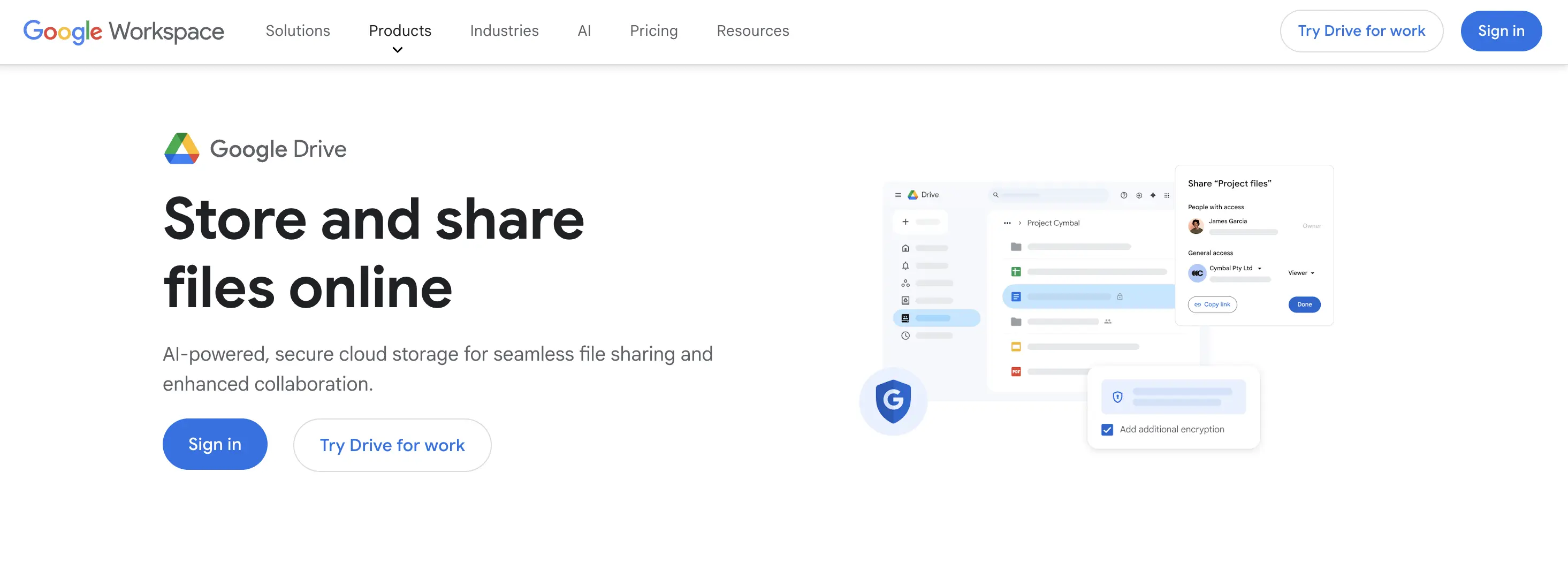
Google Drive is cloud storage with sharing features. It ends up in these comparisons because it is the most common fallback for people not using a dedicated tool. The 15 GB of free storage is generous, files never expire, and for internal team sharing it is seamless.
For external client delivery, Google Drive falls short of what Filemail already does: no desktop app acceleration, no resume support, generic Drive URLs, and a better experience if your recipient also has a Google account.
Pros
- 15 GB free, files never expire
- Most recipients already have access
- Smooth for Google Workspace teams
- Google One from $2.99/mo for 100 GB
Cons
- No branded delivery experience
- Generic Drive URLs visible to clients
- No resume support or UDP acceleration
- Not designed for professional client-facing delivery
Pricing: Free (15 GB) · Google One from $2.99/mo (100 GB)
Best for: internal file sharing within Google Workspace teams only
Google Drive vs TrunkTransfer full comparison
Choose the Right Filemail Alternative
If you deliver files to clients as a regular, professional part of your work, TrunkTransfer is the alternative that solves what Filemail does not address: what the delivery looks like to the person on the other end.
Here is what makes it the standout pick for creative professionals:
- A fully custom domain with no platform name in the URL at all. When your client clicks the link, they see only your domain. Not filemail.com, not yourstudio.filemail.com, not anything except your studio name. Filemail's branding, even on Pro and Business plans, keeps filemail.com visible. TrunkTransfer removes it entirely on the Starter plan at $9/mo.
- A delivery page that looks like part of your business. Your logo, your colors, your name on the page. The download experience your client has feels like a handoff from you, not from a third-party file service you are routing through.
- Delivery confirmation without chasing. You get notified the moment your client opens the files and downloads them. No dashboard to check, no follow-up email asking "did you get everything?" You know immediately when the delivery is done.
- Zero friction for your client. No account to create, no desktop app to download, no Filemail prompt. Click the link, see the delivery, download the files. That is it.
- Flat pricing, not per-user fees. Filemail's Business plan charges $18 per user per month. If you have even a small team, those fees compound fast. TrunkTransfer's pricing is straightforward and does not scale against your headcount.
Filemail is built to move files reliably. TrunkTransfer is built to make the moment your client receives those files feel like part of your professional brand. For a one-off transfer to a colleague, that difference does not matter. For delivering finished work to a paying client, it is the whole point.
Ready to try TrunkTransfer? Send your first branded delivery in under 2 minutes. No client signup required. Start your 7-day trial at trunktransfer.com
Frequently Asked Questions
What is the best alternative to Filemail?
TrunkTransfer is the best alternative to Filemail for creative professionals who deliver work to clients. The key reason is not just price. It is what the delivery experience looks like on the receiving end. TrunkTransfer lets you send from your own custom domain, so your client sees only your brand from the link through to the download page. No filemail.com, no third-party platform name anywhere.
You also get delivery confirmation when your client opens the files, and a branded delivery page that looks like part of your studio, not a generic file service. At $9/mo for the Starter plan, it costs less than Filemail Pro and gives you something Filemail does not offer on any plan: a truly custom domain. Try TrunkTransfer's 7-day trial at trunktransfer.com.
What are Filemail's free plan limitations?
Filemail's free plan caps you at 5 GB per transfer and limits you to 2 transfers every 24 hours. Password protection is not available on the free tier, and file links expire after 7 days. There is also no branding or custom subdomain on the free plan.
Does Filemail support custom domains?
Not in the way most people mean. Filemail offers a custom subdomain. You can choose a name like yourstudio.filemail.com, but the filemail.com portion of the URL always stays visible. A true custom domain where filemail.com is replaced entirely by your own domain is not available on any Filemail plan. If that matters to your client-facing brand, TrunkTransfer is the alternative that solves it, available from the $9/mo Starter plan.
Does TrunkTransfer work as a Filemail replacement for client delivery?
Yes, and it goes further than Filemail in the areas that matter most for professional client delivery. Filemail is a reliable file transfer tool built around the sender's needs. TrunkTransfer is built around the moment your client receives the files. You get a branded delivery page under your own custom domain, so your client sees only your studio name from the link through to the download.
Filemail's branding gives you a subdomain (yourstudio.filemail.com), but filemail.com stays in the URL. TrunkTransfer removes that entirely. You also get delivery confirmation the moment your client opens and downloads the files. At $9/mo for the Starter plan, it costs less than Filemail Pro at $12/mo and gives you a custom domain that Filemail does not offer on any plan. Try TrunkTransfer's 7-day trial at trunktransfer.com.
Does TrunkTransfer require my client to create an account?
No. Your client clicks the link, lands on your branded delivery page, and downloads the files. No account, no app to install, no Filemail-style prompt to download a desktop client for better performance. The experience is frictionless by design, which matters when your client is a non-technical person who just wants to get the files.
What are the file size limits on Filemail free plan in 2026?
Filemail's free plan allows up to 5 GB per transfer with a limit of 2 transfers every 24 hours. Links expire after 7 days. Password protection is not available on the free tier. For unlimited transfers with no daily cap, Smash or TransferNow are the strongest free alternatives.
Is Filemail good for client delivery?
Filemail is reliable for moving files, but it was not designed around the client's receiving experience. The download page is functional but generic. Branding is a custom subdomain where filemail.com stays visible. There is no delivery confirmation on standard plans. For professionals who want the delivery to reflect their brand, TrunkTransfer is the stronger alternative.


